A prospecting engine that learns which offer converts
A Facebook pixel for cold email. The AI picks the offer, pitches it, and depending on the replies promotes it more or less. The system improves on its own.
The context
My own prospecting engine, built for local businesses: vets, restaurants, garages, salons. These businesses are buried under solicitations from web agencies that know nothing about their trade, and all get the same "Hi, hope you're doing well" they delete in a fraction of a second.
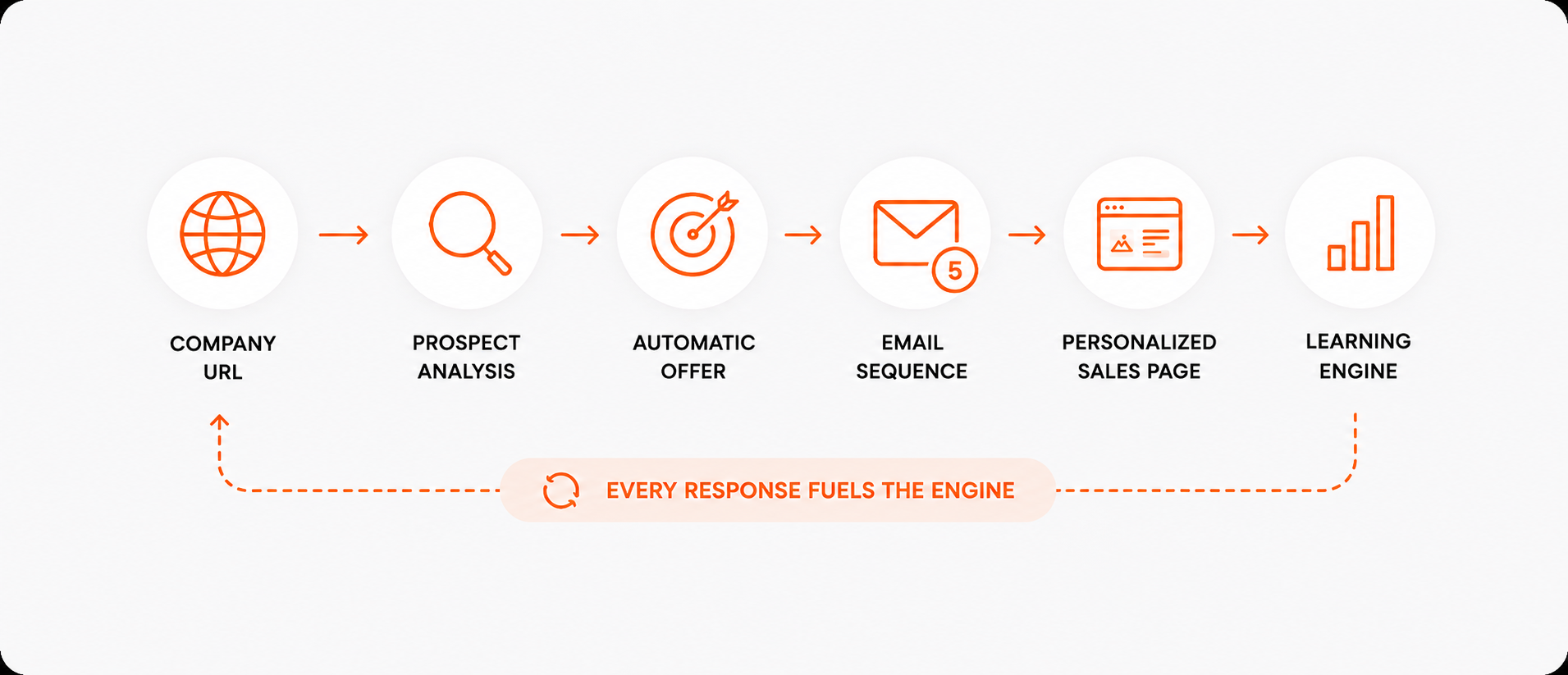
You give a company URL, the system produces a ready-to-send sequence of five ultra-personalized emails, plus a unique sales page for that specific prospect. The analysis and writing take a few seconds and cost a fraction of a cent per prospect, where a junior at an agency would spend half an hour. And above all, the engine reallocates volume on its own toward the offer-and-sector pairs that convert best.
The problem
Classic B2B prospecting is broken, and everyone pretends it isn't. You buy a list of ten thousand contacts, write a generic email, blast it, and pray for a one percent reply. The problem isn't volume, it's relevance. An email that cites a real signal, for example that the prospect's last Google review is eight months old and was never answered, converts ten times better than a generic hook. But writing it by hand for five thousand prospects is impossible. Unless an AI does it.
How it works
The pipeline has eight steps. It reads the prospect from several public sources in parallel, website, Google listing, legal registry, customer reviews, storefront. It retrieves the decision-maker contact. An LLM reads all the raw material and outputs a strategic analysis, sector, pain signals, purchasing power, likely objections, recommended angle. The system then matches the prospect to the best of five offers, generates five emails that cite real signals from the prospect, sends, automatically classifies replies, and follows up in a contextualized way when the reply is warm.
Key decisions
- LLM-first, zero hardcoded heuristics. No fixed rule like if this word then that sector. Any hardcoded list is a blind spot: the day a prospect uses a tool absent from the list, you miss them. Instead, you give the model all the raw signals and let it recognize the concept, not a list of names.
- The engine that learns, the heart of the system. A multi-armed bandit, Thompson sampling, on the offer-sector-signals triplet. The system explores uncertain offers and exploits the converting ones in parallel, and the winning pairs automatically take more volume over time. That's the pixel for cold email: it improves on its own from feedback.
- An ephemeral sales page per prospect. A personal link to their company, reusing their name, the problem detected at their place, the offer that concerns them, and full tracking. The prospect clicks out of curiosity, and every interaction feeds the learning engine again.
- A durable, idempotent architecture. A pipeline that calls scrapers, LLMs and an email layer breaks all the time. Each step is cached, retryable and idempotent, so if generation fails at step five, you resume exactly where it broke without replaying the scraping or duplicating anything. That's the difference between a demo POC and a system that runs on thousands of prospects.
What it proves
My intelligence isn't only for personalizing, it optimizes itself. The rare skill isn't calling an AI API. It's knowing where to put AI and where to put deterministic logic: analysis and writing to the model, matching to an algorithm that learns, feeding it raw material rather than constraining it with rules, and building the durable infrastructure around it. It's reproducible on any workflow where a human reads context and makes a repetitive decision.