A living observatory of AI needs
500 buying signals a week, in public, while you read this line.
The context
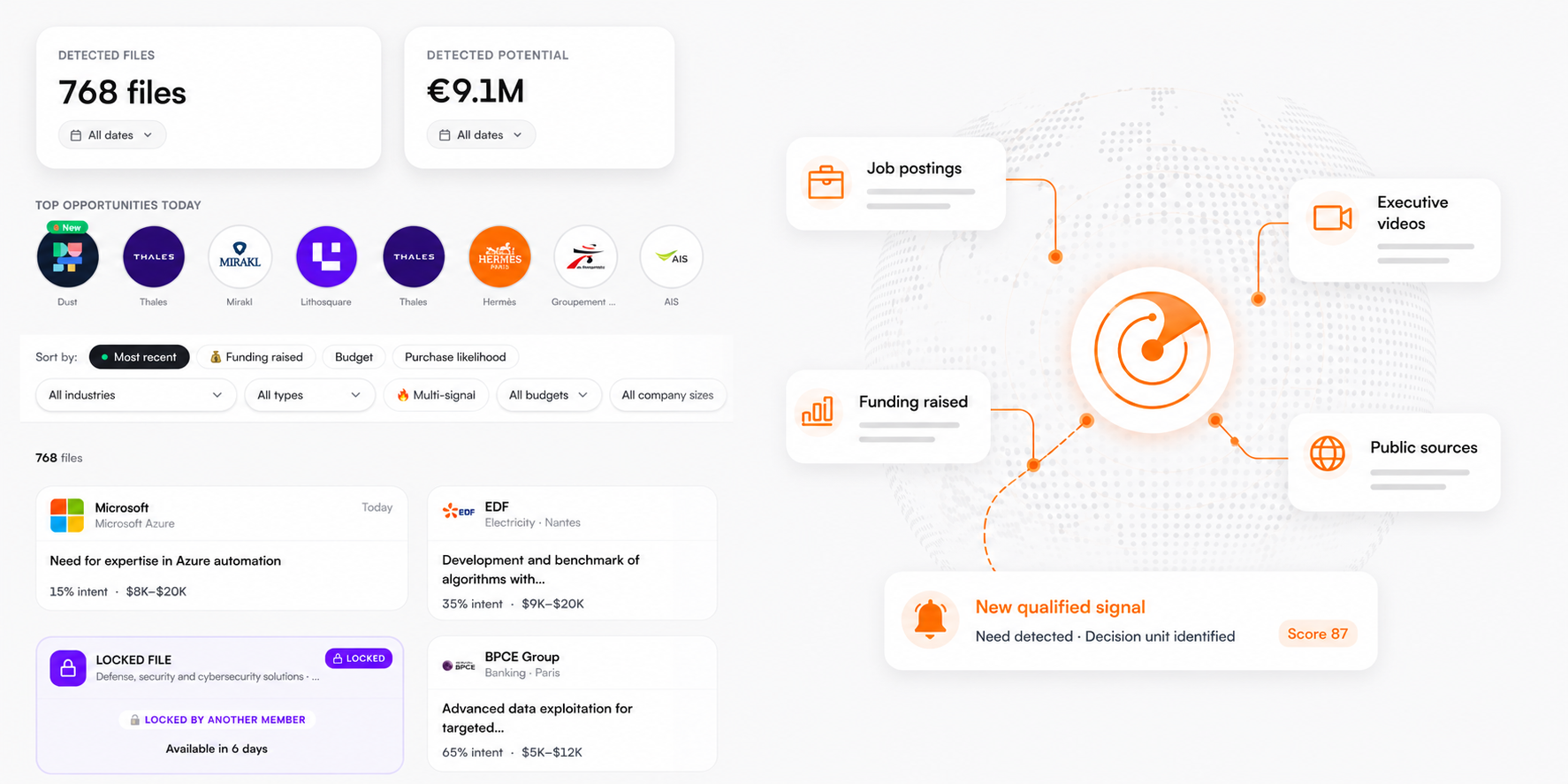
IntentRoom continuously monitors the AI and automation market in France, qualifies each buying signal, and publishes data-backed studies on the real state of demand. A multi-source system in production, not a mockup.
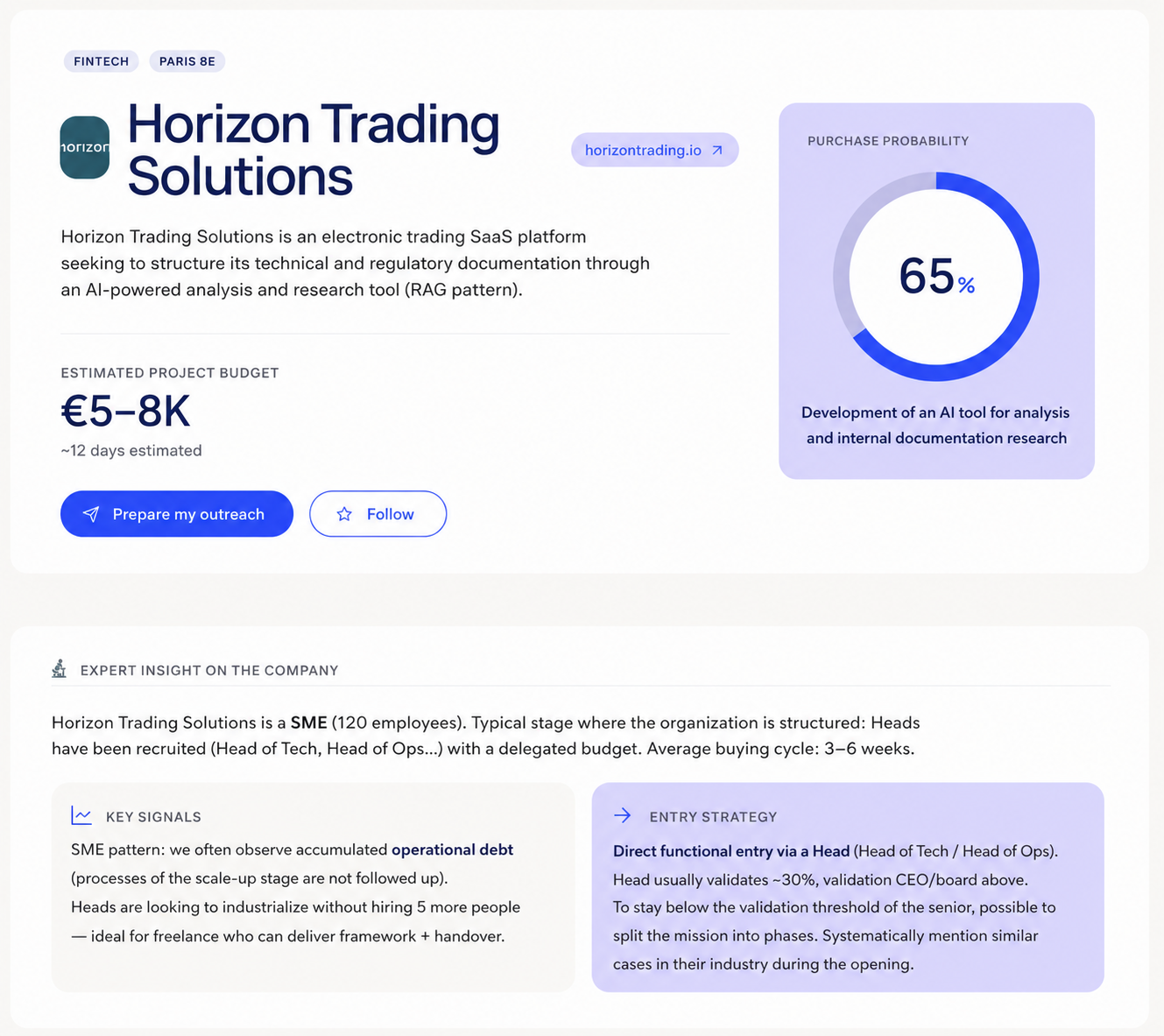
Over 500 qualified signals per week. A dashboard of actionable accounts, each delivered with a full file: the operational need decoded with its source, the decision unit, a mission budget aligned with market patterns, and a ready approach angle. The same material feeds a public, signed editorial output, a needs barometer, a Top 100 of companies to contact, which serves as proof of authority as much as a product.
The problem
Buying signal exists in public sources, but it's scattered across dozens of places, it goes stale within weeks, and it's heavily polluted. A large share of what looks like a prospect is an intermediary, recruiter, IT services firm, agency, marketplace, that masks the real client. Nobody consolidates this noise into something clean, dated and actionable.
How it works
Collection pulls from several families of public sources in parallel: job postings via an official employment API queried on a battery of keywords with a sliding window to capture only what's new, fundraises detected via real-time search, and executives speaking on video across a dozen monitored channels.
On videos, a two-stage AI filter in cascade: a small model first decides whether it's worth transcribing, a heavier model then extracts the signal. The cheap one sorts, the expensive one digs: that's the backbone of the system on the cost side.
Everything converges into a single enrichment sub-workflow: deduplication by content fingerprint, company qualification to understand what it sells and not what it recruits, setting intermediaries aside, geographic filter applied early, reading the site to extract the stack actually present, breaking the need into quantifiable modules, identifying the decision unit, then scoring. All in three tables: companies, raw signals, processed signals.
Key decisions
- Intermediary detection, which avoids wasting the approach on a mask.
- The geographic filter upstream of the costly steps.
- Stack extraction without hallucination: a tool is only kept if it's visible in the page's code, never inferred.
- A freshness cache, to avoid re-processing a company seen recently.
- Tiered enrichment under a daily quota: deep analysis for high-scoring accounts, a lighter version for the rest, depth follows value.
- A fail-safe everywhere: if an external module goes down, the signal still passes with what we have.
What it proves
Running this in production is the most direct demonstration of the thesis: proprietary signal manufactured from sources everyone can see, but that nobody assembles properly. The difficulty is never in collecting, it's in the layers of judgment. That's the capability I then install in a client's vertical.