A store's action plan, dictated by its neighborhood
Two stores of the same chain don't share the same neighborhood, so not the same plan. I generate each store's plan from its local context.
The context
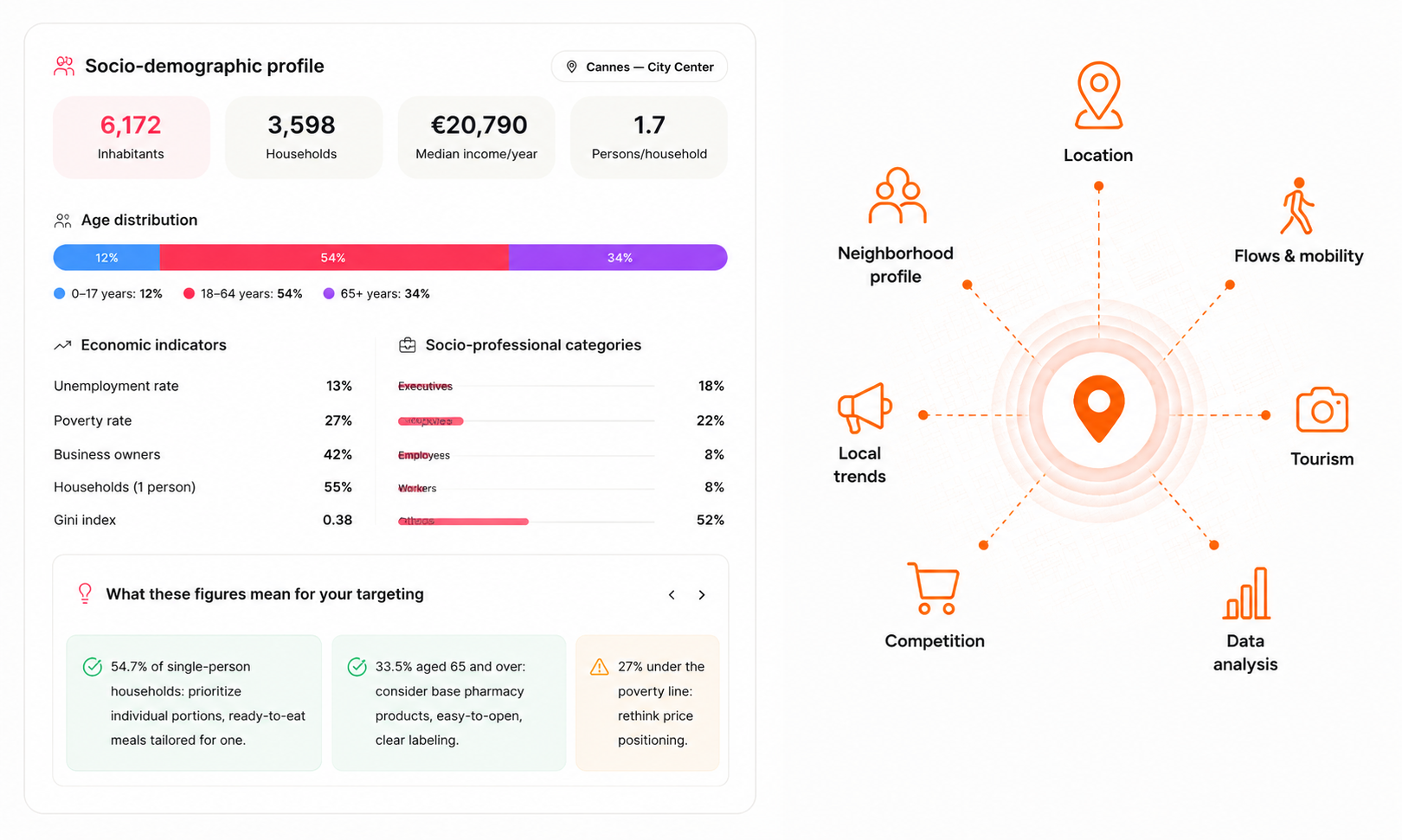
A convenience retail chain runs hundreds of stores. On paper they look alike, in reality each lives in a different neighborhood. The system profiles a store from its local environment and outputs a tailored action plan. The typical case: a premium downtown convenience store in a tourist area, foot traffic, no parking, a clientele of seniors, tourists and solo shoppers, small impulse baskets.
For this store, the system produces a ready-to-execute playbook: a store profile, three priority recommendations maximum, and for each the precise location, the implementation time, the intensity, the KPI to track and a 14-day success threshold. It all comes out in two formats, a short WhatsApp brief for the store manager who must act, and a structured export for HQ that steers. The system even shows its own confidence level on the diagnosis. The objectives are quantified and dated, for example aiming for more turnover at lunch and a higher average basket in the evening within 14 days. These are measurable targets set by the playbook, not gains already realized.
The problem
A chain runs its network with a national planogram and centralized promotions. But a downtown tourist store with no parking has nothing to do with a suburban outlet: one does light impulse baskets and nomad lunches, the other weekly grocery runs. Adapting merchandising store by store, taking the real neighborhood into account, is exactly the work a good regional director would do, and it's unfeasible by hand across hundreds of stores.
How it works
The system reads the store's public local context, its location, its neighborhood profile, foot traffic, the share of tourism, the competitive environment, and infers a store profile. From that profile and the chain's objectives, it generates recommendations ranked by priority: where to place what, which assortment to strengthen, which reference prices to set. Each recommendation is conditional, with a logic of if the store's state is such then do this, otherwise do that, and it carries its own success indicator and its 14-day threshold. The result is delivered to the field as a short brief and to HQ in a structured format.
Key decisions
- Conditional recommendations, not a rigid plan. Each action embeds its if-and-else logic based on the real state of the aisle, so it's applicable without a prior field audit, and it stays auditable, never a black box.
- Everything is measurable. Each rec comes with its KPI and its 14-day threshold. We don't ask the store to believe, we give it the means to check whether it works.
- The system shows its own confidence. When the diagnosis is only moderately certain, it says so. It doesn't oversell a plan as a certainty.
- Two recipients, two formats. A WhatsApp brief the store manager reads and applies right away, an export for HQ that must steer the network. The same intelligence, served to each in the format where they act.
- Execution discipline. Two priority actions at most, not twenty. A plan nobody applies is worthless, so the system prioritizes instead of dumping everything.
What it proves
Alternative intelligence doesn't stop at digital. The same principle, reading a public context nobody aggregates and extracting an operational decision, also works for physical retail. For a chain, the advantage is direct: each store operates according to its real neighborhood, not an average planogram designed for nobody.